
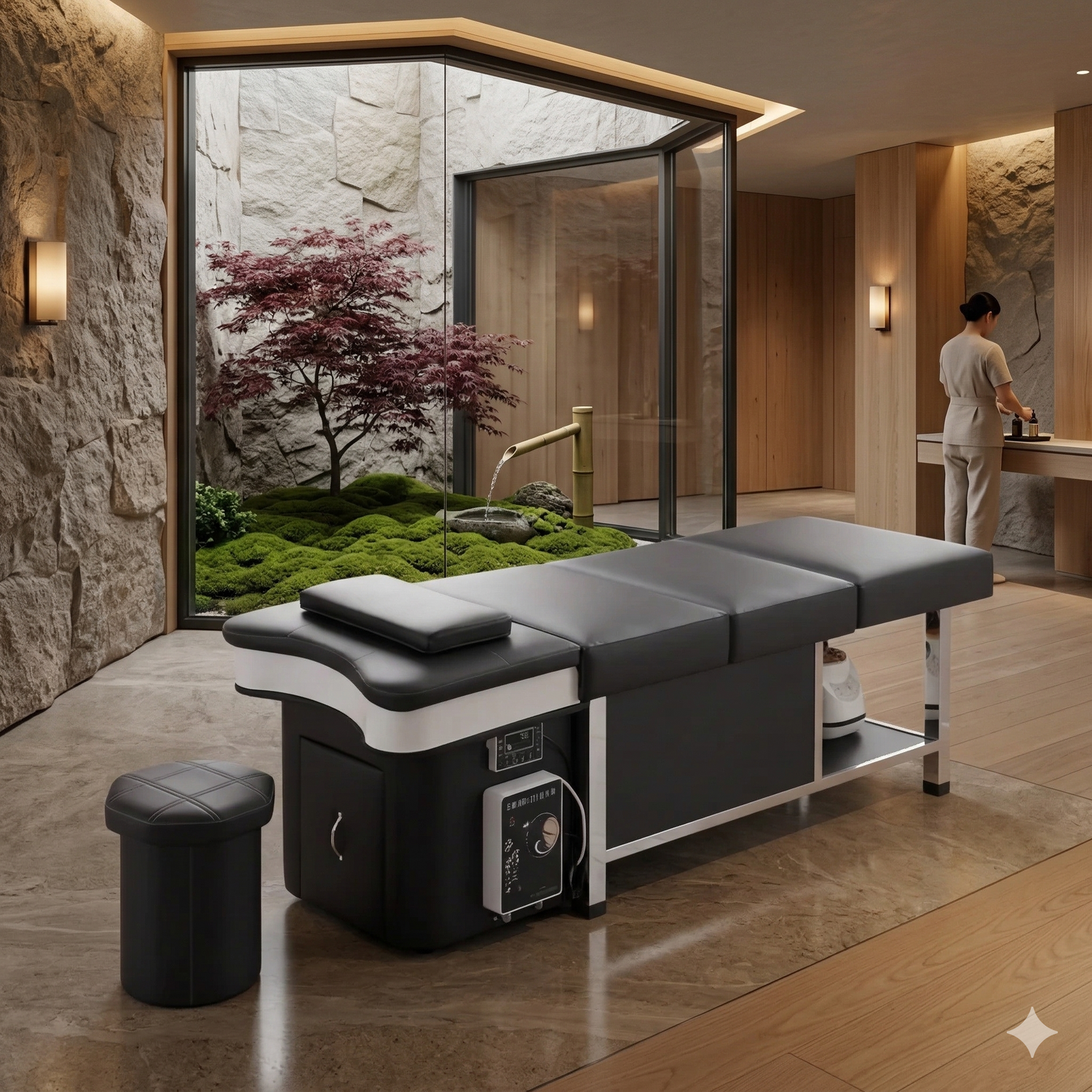
Head Spa profitability comes down to three simple variables: coherent pricing, regular use of the treatment room, and equipment suited to your business (salon, spa or institute). When the offer is properly structured, Head Spa becomes a direct lever for differentiation and retention, with a measurable impact on average ticket and repeat bookings.
A useful benchmark is to think per session: how many monthly treatments must cover the full cost (equipment plus consumables plus practitioner time) before generating margin.
Head Spa profitability as a strategic lever
Before talking numbers, set the right objective: a profitable Head Spa is not simply an additional service. It is a premium offer that improves perceived value, strengthens retention and supports a move upmarket, provided it is articulated with your existing menu of treatments and rituals. Our study on profitability per square metre helps avoid the classic traps: pricing too low, protocols too long, a diary that never fills.
Revenue impact: a high perceived-value product, sellable as a single session or as a course.
Margin impact: standardised protocol, controlled practitioner time and measured upselling.
Acquisition impact: local differentiation and better conversion of premium wellbeing prospects.
Retention impact: a memorable experience that supports courses and word of mouth.
In practice, Head Spa fits well into relaxation and stress-relief pathways, because the promise is immediately legible to a spa or institute clientele. That makes additional sales and course renewals considerably easier.
To secure profitability, the point is not to multiply product references but to choose a robust equipment base coherent with your space, then build a clear offer of durations, levels and options. Our range of professional Head Spa basins covers the options.
What makes a Head Spa profitable | Common mistake | Business effect |
A defined protocol (duration, stages, options) | Unpredictable bespoke sessions | Unstable diary, margin erodes |
Confident premium pricing | Rate aligned with a standard massage | Slow payback, difficulty reinvesting |
Professional equipment and experience | Equipment unsuited to room flow | Discomfort, mixed reviews, low rebooking |
Profitability also depends on execution quality: a mastered protocol, confident technique and a coherent experience. Our professional training standardises delivery and protects the premium promise over time.
The reasoning then follows a simple logic: total cost, investment plus running charges, set against margin per session and monthly volume. Data from the Global Wellness Institute helps situate your offer within a market where experience-led services consistently outgrow traditional beauty.
Head Spa investment: the equipment cost to anticipate
Your investment directly determines profitability. Equipment that is badly sized or unsuited to the pace of a salon or spa creates operational friction, lost time, discomfort, maintenance, and slows your return. A coherent choice secures your operation from the first weeks.
Think in total cost rather than list price. That includes the main equipment, the accessories the client experience requires, and the installation constraints. Our guide to opening a profitable Head Spa details the costs to plan for.
Professional equipment: basins, tables and key hardware
The core of your investment is the treatment station itself. Depending on your room configuration and your strategy, fixed or flexible, you will choose a basin with or without plumbing, paired with a table or chair designed for long, repeated sessions. Differences in ergonomics and robustness affect both pace and practitioner comfort directly.
Head Spa basin: plumbed for intensive use, or self-contained for installation flexibility.
Table or chair: stability, recline and client comfort determine perceived quality.
Complementary equipment: steam, scalp analysis, sensory accessories.
A well-integrated professional basin makes sequencing easier and reduces team fatigue, which improves margin over the medium term. Dedicated furniture such as the Kaisen Head Spa treatment bed secures the client experience across sessions of 45 to 90 minutes without compromising practitioner posture.
Fitting out a Head Spa room
Beyond the equipment, the room layout plays a key role in profitability. A well-considered space reduces dead time, smooths movement and reinforces premium perception. Businesses that succeed integrate Head Spa into a coherent wellbeing pathway without multiplying technical constraints.
Integrating a basin into an existing room often limits building work while improving the overall experience, provided you anticipate water, drainage and circulation around the station. Our guide to designing a Head Spa room in a small space covers the layout.
Cost item | What to watch | Impact on profitability |
Basin and treatment bed | Robustness, comfort, usage frequency | Faster payback with intensive use |
Room fit-out | Circulation, ergonomics, noise, lighting | Premium experience, better retention |
Complementary equipment | Genuine usefulness within the protocol | Controlled upsell, higher average ticket |
Finally, anticipate maintenance and upkeep. Both are frequently underestimated at purchase but decisive for equipment life, as our maintenance guide sets out.
Revenue and treatment pricing
Head Spa revenue depends mainly on two levers: the price of the treatment and the real occupancy of the room. Unlike other wellbeing treatments, Head Spa benefits from high perceived value, which permits premium positioning provided the experience is coherent and professional.
In businesses that succeed, pricing is not modelled on a standard massage. It rests on a clear promise, deep relaxation and scalp expertise in a Japanese-inspired ritual, and on a structured protocol that is easy to explain at the point of booking. Our guide to pricing a premium ritual covers the reasoning.
Pricing by type of business
Your price varies with the context: hair salon, beauty institute or spa. Each configuration implies a different level of expectation and a different tolerance to price. The key is aligning your rate with the setting, the duration and the perceived level of expertise.
Hair salon: positioned as a signature treatment or a premium add-on.
Beauty institute: integrated into a wellbeing menu with course sales.
Spa: an immersive ritual, longer duration, heightened sensory experience.
In every case, coherence between the message, the protocol and the environment is essential. Businesses that work on the visibility of their Head Spa generally see better acceptance of premium rates and more stable booking levels.
Occupancy and session frequency
Beyond the headline price, profitability rests on maintaining regular occupancy. A profitable Head Spa is not necessarily the one with the highest rate, but the one whose room is used consistently without disrupting the schedule.
High-performing businesses set a target number of weekly sessions, then adjust their communication and offers, courses, subscriptions, gift cards, to smooth activity across the week.
Variable | Good practice | Impact on revenue |
Price per session | Aligned with perceived value and setting | Higher average ticket |
Protocol duration | Standardised and controlled | Better room turnover |
Session frequency | Courses and retention | Recurring, predictable revenue |
Margin and the operating costs to control
Margin does not depend only on your headline price. It is built in daily execution: practitioner time, consumables, maintenance and diary organisation. A business can generate high revenue while degrading its profitability if it fails to control these.
Distinguish the fixed costs tied to your initial investment from the variable costs per session. That is what identifies the threshold beyond which each treatment genuinely contributes to margin.
Practitioner time, consumables and recurring charges
The first recurring cost is practitioner time. A poorly defined protocol, too long or too dependent on manual intervention, mechanically reduces margin per session. A clear sequence optimises room turnover without degrading the client experience.
Practitioner time: the real duration, including preparation and resetting the room.
Consumables: hair products, linen, water, energy.
Indirect charges: upkeep, electricity, equipment wear.
Accessories should stay coherent with the protocol rather than multiplying cost centres. A considered selection from our treatment room accessories improves premium perception without weighing down your charges.
Maintenance and equipment durability
Durability plays a key role in medium and long-term margin. Equipment designed for intensive professional use limits service interruptions and unexpected costs. Under-specified equipment produces recurring breakdowns and indirect revenue loss, as our analysis of total cost of ownership demonstrates over 24 months.
Cost item | Point of attention | Effect on margin |
Practitioner time | Real duration versus billed duration | Directly affects margin per session |
Consumables | Dosing and standardisation | Stable variable costs |
Maintenance | Preventive rather than corrective | Fewer operating losses |
Return on investment: how long before the equipment pays for itself
Return on investment is the time needed for the margin generated by treatments to cover your initial outlay, equipment plus fit-out. In a salon, spa or institute, that timeline depends less on total volume than on the regularity of sessions and the net margin per treatment. Our analysis of equipment ROI works through the scenarios.
Payback scenarios by type of business
Each type of business has different constraints. What profitable projects share is the ability to reach a monthly session threshold without disorganising existing activity.
Hair salon: added alongside existing services, in targeted slots.
Beauty institute: course sales and retention, a more evenly filled diary.
Spa: long rituals, high average ticket, lower turnover but higher margin per session.
What accelerates or slows your payback
Factor | Effect on payback | What it means commercially |
Occupancy rate | Major accelerator | More sessions means faster amortisation |
Margin per session | Direct effect | Protocol and price properly calibrated |
Equipment quality | Stabiliser | Fewer stoppages, continuous operation |
Lack of visibility | Brake | Room left underused |
Businesses that actively work on local visibility and their value proposition significantly reduce payback time. A targeted communication strategy usually fills the room faster, without resorting to discounting that damages your positioning.
Making a Head Spa profitable in a beauty salon
Making a Head Spa profitable rests less on adding a new service than on integrating it properly into your existing offer. Treated as an isolated treatment, it stays underused. Built into a coherent client journey, it becomes a powerful lever for revenue and retention. Our guide to adding a Head Spa service covers the launch sequence.
Integrating Head Spa into your existing menu
Signature treatment: a standalone session positioned as a premium experience.
Add-on option: attached to an existing hair or wellbeing service.
Course: several scheduled sessions that smooth your revenue.
Upselling, retention and moving upmarket
The second profitability lever is a controlled move upmarket. The point is not to multiply options but to offer coherent additions that reinforce the perceived value of the session.
Sensory elements: warm towels, ambient sound, aromatherapy.
Equipment that improves comfort and relaxation during the session.
Scalp analysis to personalise the treatment and reinforce your expertise.
Retention also comes from consistency. A mastered protocol, a considered atmosphere and professional technique encourage clients to return and recommend you. Our guide to professional scalp massage covers the technique that carries that perception of quality.
Which businesses profit most from the Head Spa model?
The Head Spa model is not universal. Its profitability depends heavily on the type of business, the maturity of your wellbeing offer and your ability to integrate the treatment into a coherent client journey.
Type of business | Why the model works | Profitability level |
Spa | Long rituals, high perceived value | Very high |
Beauty institute | Courses and retention | High |
Hair salon | Differentiation and moving upmarket | Varies with positioning |
A profitable decision, under conditions
Head Spa profitability is neither automatic nor reserved for a few. It rests on structuring choices: suitable professional equipment, a mastered protocol, coherent pricing and intelligent integration into your existing offer.
The strongest projects shift the thinking from cost to value created: client experience, retention, premium image and recurring revenue. Well executed, the treatment becomes a genuine competitive advantage in an increasingly demanding market.
For salons, spas and institutes wanting to structure their project and secure their return, our business plan model works the full cost structure through, and our team is available if you want the numbers run against your own business. Contact a specialist.
FAQ
Is a Head Spa genuinely profitable for a salon or institute?
Yes, provided it is used regularly and integrated into a structured offer. Profitability depends mainly on occupancy, pricing and your ability to sell courses or complementary options. In well-organised businesses, Head Spa becomes a lever for differentiation and recurring revenue.
How long does payback typically take?
It varies with your level of equipment, your prices and session frequency. In a well-managed professional setting, payback is generally observed within a few months to a year, when the room is used consistently and margin per session is correctly calibrated.
Which type of business profits most?
Spas and beauty institutes often see the best results thanks to a clientele accustomed to premium wellbeing treatments and courses. Premium-positioned hair salons can also generate strong profitability, provided Head Spa is treated as a signature treatment rather than a simple option.
Do you need high prices to make a Head Spa profitable?
Profitability rests not only on a high price but on coherence between rate, client experience and duration. Confident premium positioning makes it easier, but a mid-range rate can also work if occupancy and retention are strong.
Which costs most affect your margin?
Practitioner time, consumables and equipment maintenance. A protocol that is too long or poorly standardised erodes margin quickly. Smooth organisation and durable professional equipment stabilise costs and improve profitability over time.
Is training essential to profitability?
Training is not a constraint but an accelerator. It standardises technique, protects session quality and optimises practitioner time. A trained team sells the treatment more easily, retains more clients and reduces quality variation between sessions.
Can a Head Spa be profitable at low volume?
Yes, provided you work on value per client. Businesses with moderate volume but a loyal clientele and a high average ticket can reach satisfactory profitability through courses, options and a stronger experience.